
Major industrial accidents rarely come down to a single failure. In every case, such as Piper Alpha, Texas City, Buncefield, and Deepwater Horizon, investigators found that several protective measures failed at once, and not that one system broke down in isolation. Equipment problems, procedural gaps, human error, and organisational weaknesses combined to let a hazard escalate past the point of control.
That’s the reason high-hazard industries don’t think about safety as a set of individual systems anymore. They think in terms of layers of protection working together, such as barriers. Barrier management is the discipline of identifying, monitoring, and maintaining those barriers, thus safeguarding the facility.
What Is Barrier Management?
Barrier management is the structured process of ensuring that the safeguards designed to prevent major accidents stay effective throughout operation.
Norway’s offshore regulatory guidance (Havtil, formerly PSA Norway) focuses on a barrier as a function that performs rather than on the hardware that happens to deliver it. In other words, Havtil focuses on the barrier not only being the relief valve, but rather the function of preventing dangerous overpressure. The valve is just one of several elements that deliver that function; it also depends on the instrumentation around it, the maintenance program that keeps it in working condition, and the people who test it and respond when it’s called on.
That distinction matters because it changes what gets managed. Instead of tracking whether a piece of equipment exists and was inspected on schedule, the organisation is tracking whether a protective function can detect a gas release, isolate hydrocarbon inventory, and suppress a fire, all of which can still be relied on right now. A gas detector that passes calibration but triggers an alarm nobody responds to in time hasn’t delivered the barrier function, even though “the equipment is fine” on paper.
Norwegian regulation requires operators to know their status during operation, which is impaired, what compensating measures are in place, and what that means for the current risk picture. That is a different bar than having a barrier register and an inspection schedule.
Why Knowing Barrier Status Is the Real Challenge
Ask most facilities a simple question: how many critical barriers are currently impaired? Many can’t answer immediately. They know the equipment exists. They know maintenance is scheduled. What they usually don’t have is a current, consolidated answer.
That gap is worth naming directly: barrier management is about knowing whether the barriers can perform their intended function at this moment. A barrier register lists what should exist. It doesn’t show what’s impaired today. A bow-tie diagram shows how a barrier is supposed to work. It doesn’t show that it’s currently isolated for maintenance.
A facility’s barrier-relevant data lives across dozens of systems: incident management, inspection and maintenance, permit-to-work, control system historians, shift logs, audit findings. Each system can show the condition of the piece it’s responsible for. None of them, on their own, can answer “which barrier functions are degraded right now, and what does that mean across the facility?” A bow-tie visualisation linked to those underlying source systems, showing close to real-time status and changes that are brought together in one place, it becomes possible to see which barriers are degraded and what that means for the facility as a whole.
For example, a compressor’s maintenance is five days overdue, with low risk on its own. Separately, a loss-of-containment event on a nearby valve had its root cause identified but not yet fixed, and there’s a temporary change in place on a pressure relief valve, which is medium risk on its own. An operator now wants to start hot work nearby, which is a medium risk on its own. None of these, viewed separately, are alarming. Viewed together, in the same area, at the same time, they can add up to a high-risk situation that no single system would have flagged.
How This Relates to Barrier Monitor
This is the operational gap Barrier Monitor is built to close.
Rather than tracking equipment in isolation across separate systems, Barrier Monitor pulls barrier-relevant data from the systems that are responsible, such as maintenance, inspection, permits, incidents, and keeps a live, consolidated view of barrier health and impairment status. The goal isn’t to replace the systems where each barrier element is managed day to day; it’s to give both groups who depend on barrier status a shared, current picture:
- Office-based teams, asset integrity, HSE, and risk managers- who need to know barriers are healthy and that degradation is being tracked and acted on.
- Frontline teams, operations and maintenance- who need that same status visible at the point where it affects a decision, like issuing a permit for hot work in an area with a known impairment nearby.
That’s the difference between having documented barriers and having managed barriers: the ability to see, in something close to real time, whether the safeguards a risk assessment assumed are still standing.
“Norwegian HES Management regulations require that barriers are analysed and that the status of barriers is known during operations of installations.” (Vinnem, 2014, p. 522)
Safety Barriers: What They Actually Are
Every industrial process contains hazards. A barrier exists to interrupt the path from hazard to consequence, generally through one of four roles (Sklet, 2006) :
- Prevent — stop hazardous events from occurring at all.
- Detect — identify an abnormal condition before it escalates.
- Control — limit how far a hazardous situation escalates.
- Mitigate — reduce the consequences once an event has occurred.
A flammable storage tank illustrates this well: a high-level alarm detects abnormal filling; an automatic shutdown prevents overfilling; secondary containment controls the extent of a release; firewater systems mitigate the consequences if ignition occurs. No single barrier does all the work, the overall risk depends on how well the layers hold together, and it changes the moment one of them degrades or becomes unavailable, even before anything visibly goes wrong.
Barriers are typically grouped into three categories, and most barrier functions depend on more than one working together (Havtil, 2017):
- Technical — pressure relief valves, safety instrument systems, fire and gas detection, HIPPS, deluge systems, secondary containment.
- Operational — permit-to-work, isolation procedures, shift handover, operating limits, preventive maintenance routines.
- Organisational — competency management, training, leadership and safety culture, management of change, audits.
Weak organisational barriers are often the quiet cause behind the slow degradation of the technical and operational ones. For example, a facility can have excellent equipment and still have poor barrier performance if the people responsible for maintaining and operating it are undertrained, overloaded, or working from outdated procedures.
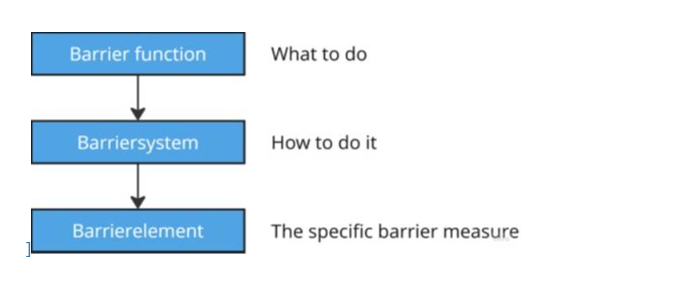
Performance Standards: Defining what Effective means.
Identifying a barrier function is only the first step. An organisation also must define, in measurable terms, how well each barrier element needs to perform the function to count as effective. That’s a performance standard.
Common requirements include:
- Availability — is it ready when it’s needed?
- Reliability — does it perform consistently, call after call?
- Capacity — can it withstand the demand placed on it?
- Response time — does it act quickly enough?
- Integrity — has it held its design condition over time?
- Independence — does it operate independently of the hazard it’s protecting against?
- Maintainability — can it be inspected, tested, and repaired efficiently?
Performance standards set late in a design process tend to produce delays, added cost, and, counterintuitively, less robust barriers because, by the time they’re defined, the design has already locked in assumptions that are expensive to change. Getting barrier functions and rough performance expectations on the table early tends to beat treating performance standards as a late-stage documentation exercise.
Barrier Degradation and Impairment
No barrier stays effective forever. Components age, procedures drift, organisations change. Left unmanaged, barrier performance degrades often gradually, without anyone noticing until a real event tests it.
Common causes: corrosion, instrument calibration drift, maintenance backlog, temporary overrides, software configuration errors, competency gaps, procedural non-compliance, and environmental conditions outside the original design basis. When a barrier no longer meets its defined performance standard, it’s impaired. Managing that well means identifying impairments quickly, assessing how much the risk picture has shifted, putting compensating measures in place where needed, and restoring the barrier as soon as practicable. This is where the difference between documenting barriers and managing them shows up most clearly, impairment management is a continuous, live process, not a periodic audit finding, and it depends on knowing, close to in real time, what state a facility’s barriers are in.
Presight Barrier Management provides a live, structured view of barrier status, helping teams identify degradation early, understand how it affects the overall risk picture, and act before performance is compromised. See how Presight can support continuous barrier monitoring and more proactive impairment management here: Barrier Management – Presight Solutions AS
Sources
Havtil (Petroleum Safety Authority Norway), “Prinsipper for barrierestyring i petroleumsvirksomheten” (2013);
Jan Erik Vinnem, Offshore Risk Assessment, (2014) Vol. 2 , pages 522
Sklet, S. (2006). Safety barriers: Definition, classification, and performance. Journal of Loss